








In 2024, Splash surveyed marketers to better understand their approach to event marketing and how it impacts their business goals.
We found that while marketers believed in the power of in-person, virtual, and hybrid events, many struggled to access the data they needed to scale their programs. Meanwhile, marketers who embraced an event-led growth (ELG) approach pulled to the front of the pack.
As a refresher, ELG refers to the go-to-market approach in which events are used as a company’s primary channel for customer acquisition and retention.
ELG focuses on creating data-driven programs that integrate with larger marketing and company initiatives. This enables organizations to provide as much value as possible to their growing customer base using event programs at scale.


2024 Takeaways
US-based teams that adopted ELG were 75% more likely than those that didn’t to see a growth rate of over 50% in 2023. These teams were also 22% more likely to meet their company revenue and/or pipeline goals.
Now that we’ve settled into 2025, it’s time to take stock of how the world of event marketing has shifted over the past 12 months. To accomplish this, Splash surveyed over 1,000 U.S.-based marketers involved in their company’s event programs.
We found that buy-in on the value of events remains strong: 90% of marketers say that events help their company stand out from the competition, and 89% say events are critical for business growth.
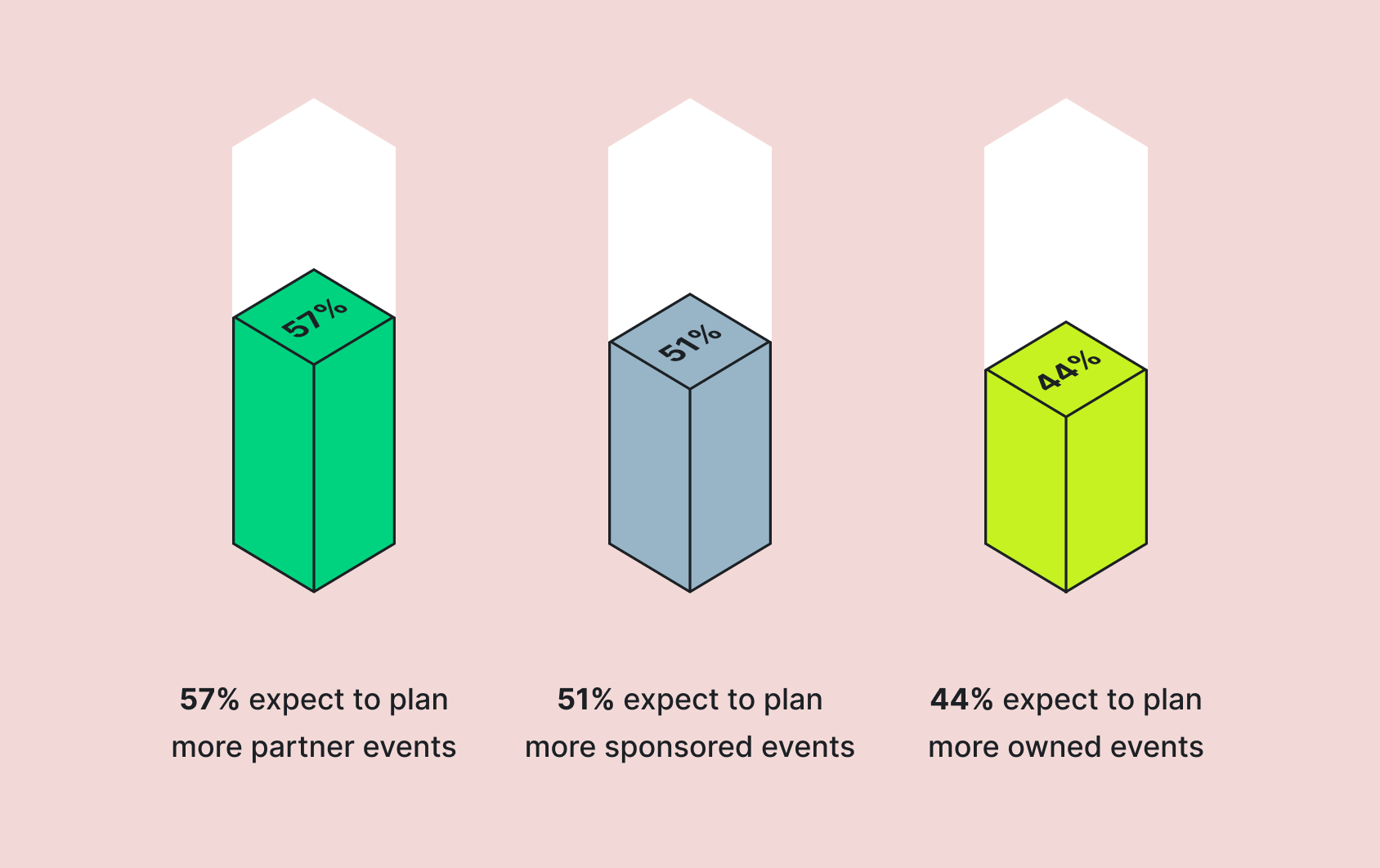
This is leading them to plan more events than ever before:

And they’re spending a sizable amount of time doing so: 23% of marketers say they spent over 60 hours per event on creating, planning, and hosting.
As a result, businesses are upping their marketing budgets: 69% of marketers say their company plans to increase its total marketing budget over the next 12 months. More than half (55%) say that at least 20% of this total budget goes towards events (not including overhead).
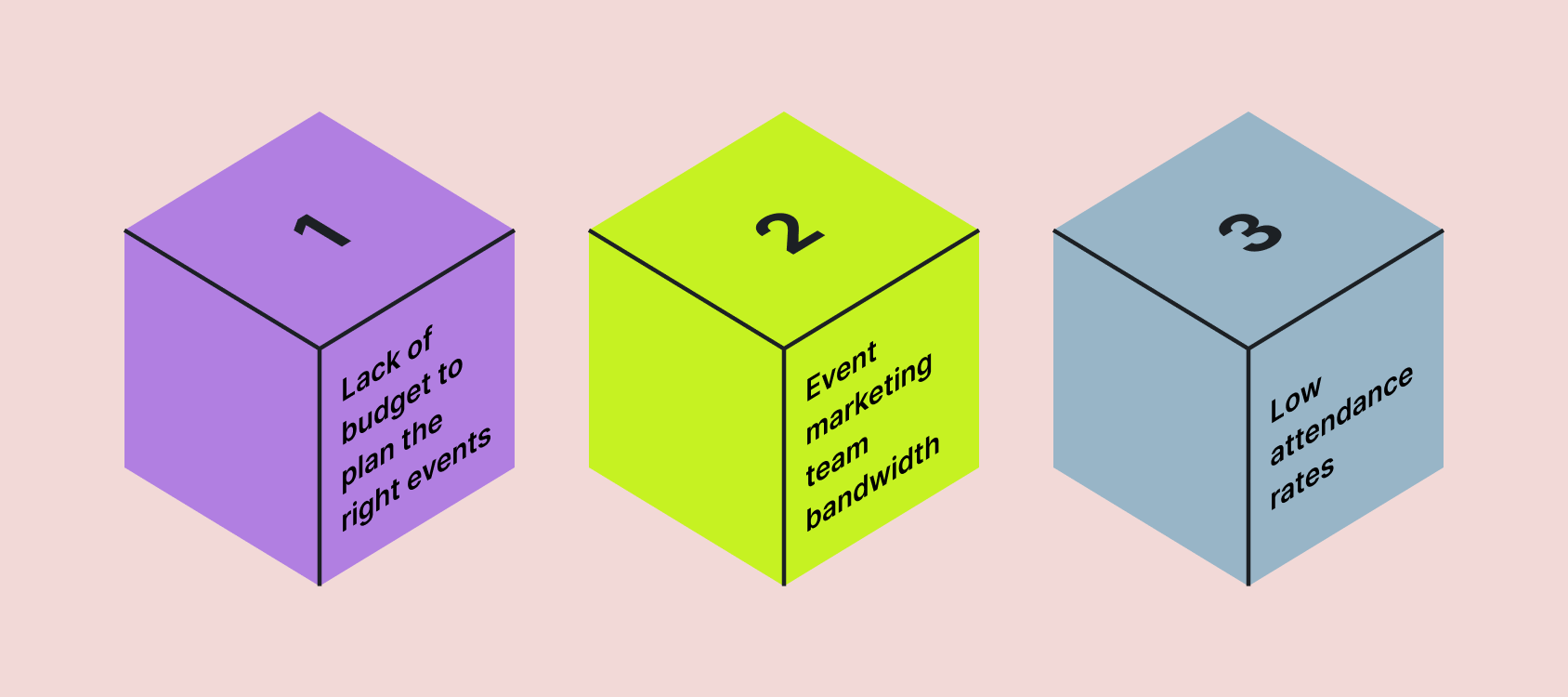
But even as event teams hit their stride, they are still experiencing a number of difficulties. Here are the top three challenges that event teams face:
The ROI of events is clearly demonstrated in the bottom line—so much so that nearly three in four marketers (72%) listed events as their company’s most effective marketing channel. Another 88% shared that events helped their team generate a steady flow of revenue, with 76% hitting their revenue goals every single quarter in 2024.
The In-Person Difference
In 2024, in-person events took a clear lead in terms of effectiveness. 66% of marketers who hosted events in multiple formats (in-person, hybrid, and virtual) said that in-person events generated the most revenue in 2024. That’s a 12% increase from those who said the same about their 2023 events.
Events are the key to moving customers through the pipeline and getting deals closed. In fact, 52% of marketers attribute at least half of their company’s 2024 closed-won deals to events. What’s more, 72% of respondents said that when prospects attend their events, deals close faster, and 31% report a 20-30+ day decrease in their sales cycle due to their events.

It should come as no surprise that companies are putting their full weight behind event planning in 2025:
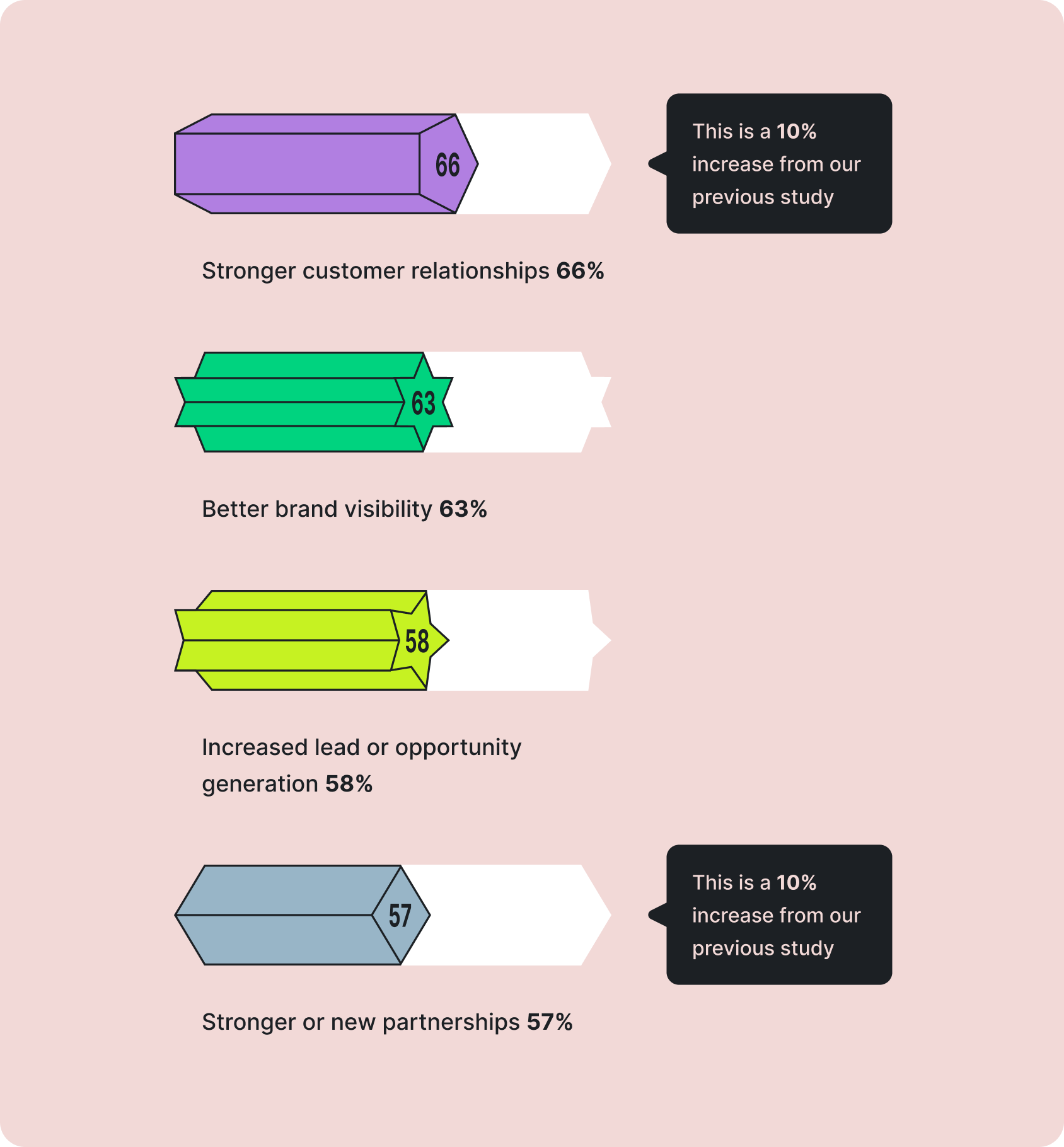
It’s important to note that revenue isn’t the only motivation for upping event investments. Companies are reaping non-revenue outcomes as well, including:
To put it simply, there’s no shortage of evidence that events are effective.
Events are key to winning over prospects and keeping existing customers happy and connected to their favorite brands. And there’s a vast array of event types companies are hosting:

Conferences, trade shows, and product launches unsurprisingly emerged as the most popular and effective event types for prospects and customers respectively. While product launches help expand existing customer accounts, conferences and trade shows put businesses in front of new audiences that fit their ideal customer profile (ICP).

But how do marketers determine whether or not an event was “successful”? There’s no one-size-fits-all answer. Instead, success depends on factors like the goal of the event, overarching business objectives, and more.
That said, there are three common metrics marketers track: event registrations (47%), attendance rates (59%), and opportunities created (50%).
However, proving impact is often easier said than done. Some teams are still falling short when it comes to measuring success. While their efforts have marginally improved year-over-year, marketers listed the following roadblocks:
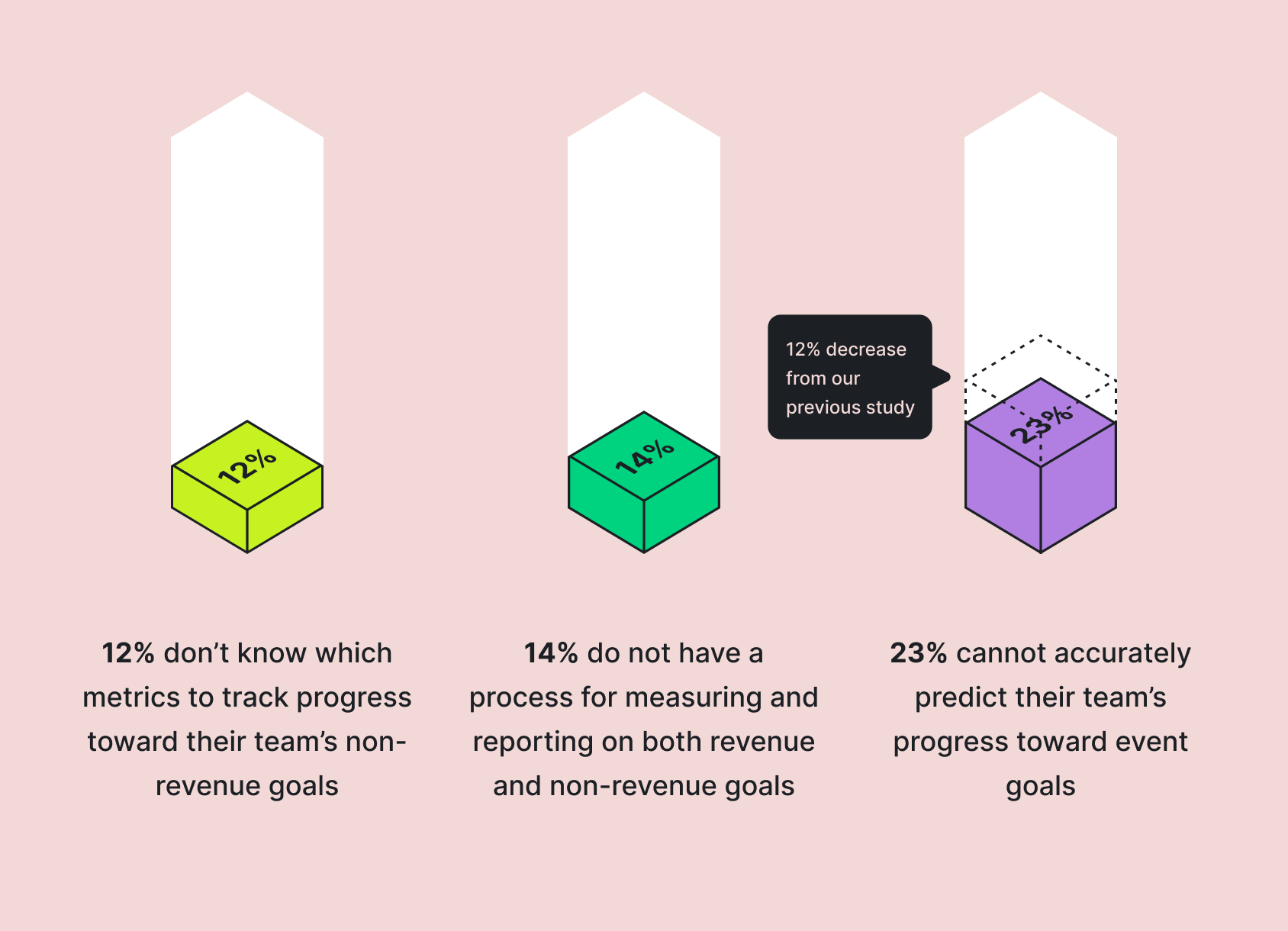
This means many marketers have difficulty proving the impact of their events. 18% of marketers reported a lack of event data as one of their challenges for proving impact on business goals. Of these respondents, 41% cited they weren’t able to accurately track pipeline generation. An additional 35% of these said they don’t have an attribution model in place for events, and those that didn’t use event technology in 2024 were 46% more likely than average to say this.
Industry Snapshot
The challenges event marketers face in demonstrating the impact of their events vary from industry to industry:
It’s hard for companies to achieve overall marketing goals when marketers can’t track their progress: 40% of marketers told Splash they frequently struggled to meet registration and attendance numbers and/or set realistic goals based on their budgets in 2024. What’s more, 41% frequently struggled to properly measure event ROI and/or create competitive events. Note: CMOs were 29% more likely than average to say they struggled to create competitive events, i.e. events that help them stand out from their competitors.
Once again, event-led growth proved to be the key to marketing success in 2024.
67% of marketers used an event-led growth approach last year.
The ELG Difference
Marketers who adopted ELG were a whopping 140% more likely than those who didn’t to have an average company growth rate of over 50%.
ELG-enabled teams are reaping a variety of rewards, including:
The power of event-led growth is indisputable. Marketing teams empowered by ELG are surpassing those that have yet to embrace the approach:
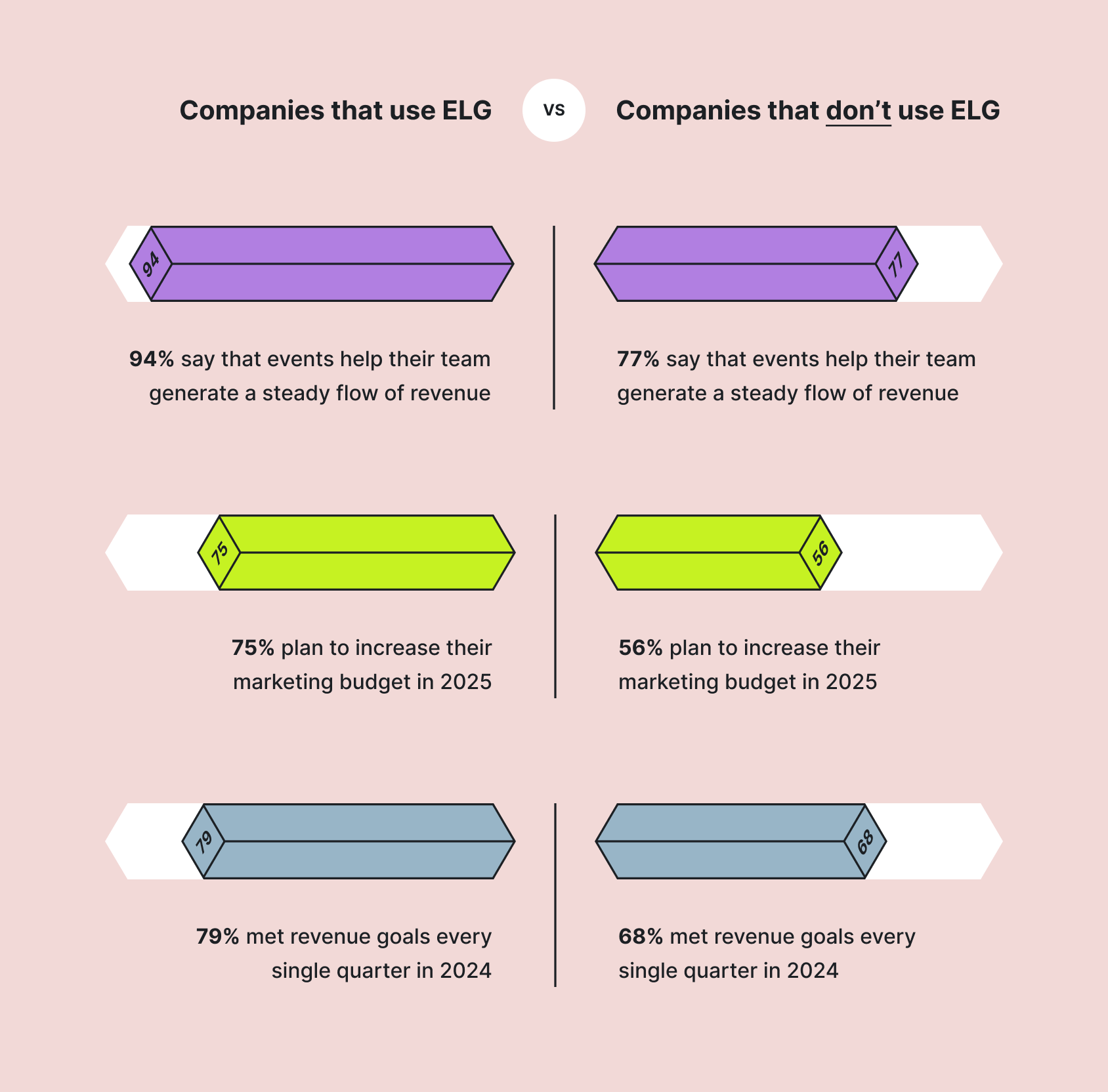
Teams that haven’t jumped on the ELG bandwagon yet are yearning to do so: 50% of these teams believe their events are underperforming because they don’t use ELG (that’s a 9% increase from last year!), leading 71% to say their company would benefit from such a strategy.
Nearly half of those who aren’t currently using ELG (48%) plan to make events their primary channel for customer acquisition and retention in 2025. This means pressure to adopt a more strategic approach is mounting rapidly.
Event technology has emerged as a force multiplier for marketing teams. Tools that enable marketers to execute more effective events—and track the metrics most important to them so they can scale success—are a core part of any ELG strategy.
78% of marketers used event technology in their efforts in the past 12 months, and 88% have plans to invest in event technology in 2025. Event tech is becoming a must-have in the larger martech ecosystem, with 68% of marketers using an event platform that integrates with the rest of their tech stack, including their CRM.
More Tech = More Events
77% of marketers say their company would host more events if they had technology that made it easier to create and replicate events. CMOs were 16% more likely than average to say this.
Many have their eyes set on artificial intelligence, even if they aren’t certain how to leverage its power just yet. When asked about the biggest trends for 2025, the term “AI” was mentioned 206 times. That data revealed that 37% of marketers don’t know how to effectively use AI in event planning, which indicates a massive opportunity for AI upskilling and education.
However, those who use an ELG approach were an impressive 60% more likely than those who do not to say they do know how to use AI in their event planning—yet another example of how these teams remain ahead of the curve.
When asked what else is on the horizon for 2025 events, personalized event experiences was a close second.
Here’s what some respondents had to say:

Leveraging data-driven insights to create highly personalized and immersive experiences for attendees.
Marketing Specialist/Coordinator
Media and Entertainment Industry
The biggest trend for event marketers will be hybrid and virtual event integration, combining in-person and digital experiences for broader reach and engagement. Additionally, data-driven personalization and AI-powered event experiences will play a major role in creating tailored, impactful events.
Sr. Manager / Manager of Marketing
Finance Industry
While other trends like hybrid events and community building will also be important, I believe hyper-personalization will be the most transformative, as it touches every aspect of the event experience and has the potential to significantly improve attendee engagement and drive business outcomes.
Sr. Manager / Manager of Marketing
Technology and Software Industry
As business objectives, technologies, and the market constantly evolve, one thing remains certain: events are a powerful marketing tool. In 2025 we expect to see an increase in the number of events planned, as well as a steady shift towards event-led growth adoption. And as companies invest in more ways to support ELG initiatives, event tech is becoming a pillar in the martech stack.
Businesses that empower their marketing teams to execute impactful events—and access the metrics they need to replicate success—will be poised to dominate in 2025.
Learn more about how event technology can help you market, measure, and scale your in-person, hybrid, and virtual events.
Splash, a Cvent company, empowers everyone within an organization to host on-brand, measurable, repeatable, and compliant event programs and digital experiences at scale. Splash helps companies execute more impactful events through brand-compliant templates, real-time integrations, and deep insights into attendee engagement and event ROI. Using Splash, event professionals and teams can simplify their processes, amplify their brand, measure their results more effectively, and grow their event programs through a single, powerful platform. See why Fortune 500 companies choose Splash to power their events at splashthat.com.
The 2025 Outlook on Events survey was conducted between January 15 and February 18, 2025. Splash surveyed a total of 1,058 respondents in the United States who work in marketing full-time and have a hand in their company’s events program. The study was conducted at 95% confidence with a +/- 3% margin of error.


%402x.png)