Four Tactics to Become an Effective Event Facilitator
One-way communication is over. It’s been over for a long time. And we learned during the pandemic that it’s not just over — it straight up doesn’t work.
Successful events feature engaging, interactive, and memorable content. The kind that places the attendee in the center, and at best, provides space for life-changing encounters and realizations. Speakers rambling on stage reading off a PowerPoint don’t create that space. So what does?
Thinking and acting like a facilitator.
Whether your presentation is 10 minutes or an hour, the magic lies in facilitating an experience of your content — not just presenting it. And to do that, your presentation mustprioritize engagement.
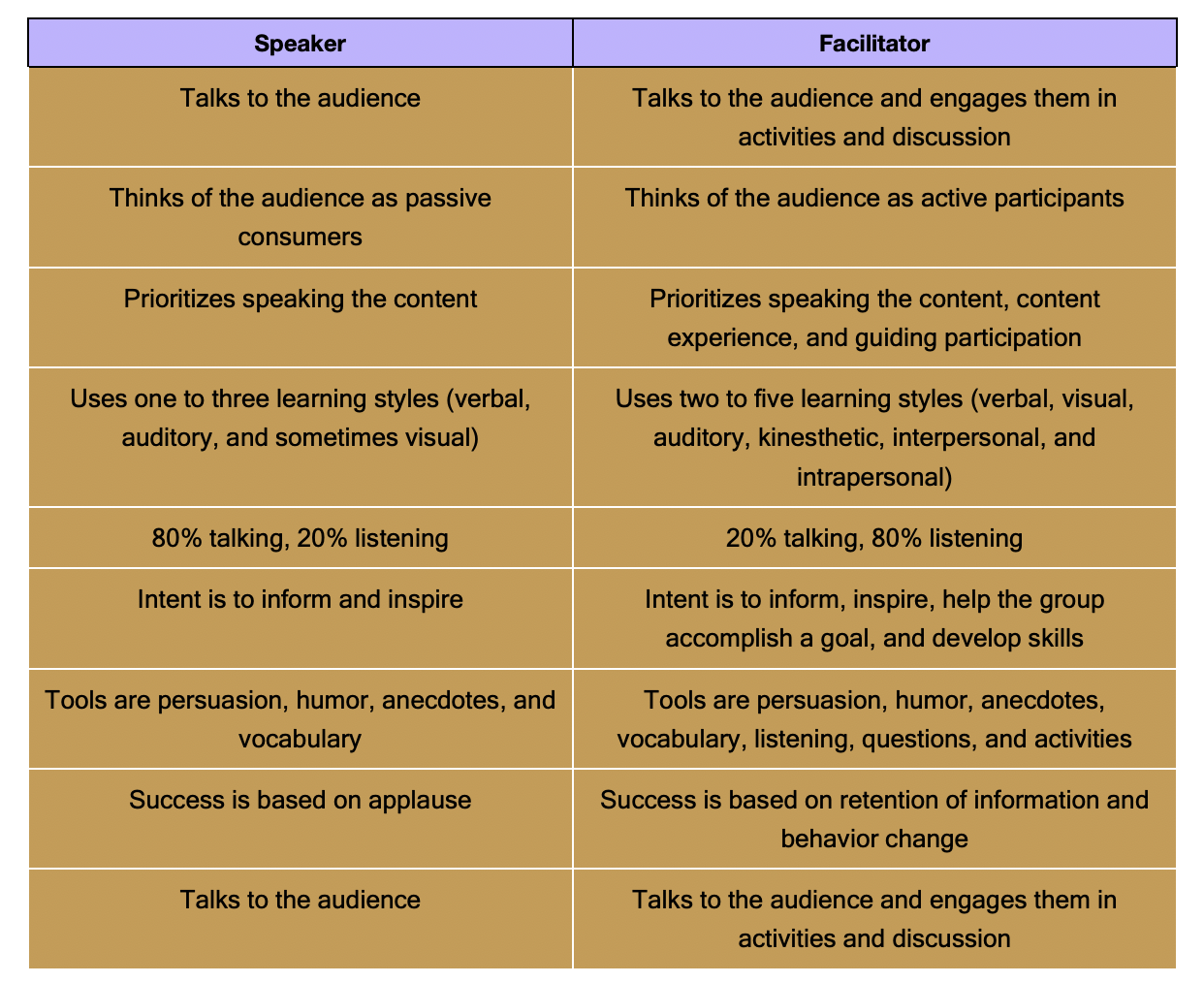
It’s not difficult, but it does require a few mindset shifts to start thinking and acting like a facilitator. Here are a few of the key differences:
Now that we know the differences between being a speaker and a facilitator, let’s look at four ways you can create engaging events using this new mindset.
1. Ask clear and concise questions.
Questions are the most important tool for learning. There’s a reason we use them everywhere: presentations and events, of course, but also in school, while building relationships, and in everyday conversations.
There are actually multiple types of questions, and asking your audience a mix of them will generate new ways of thinking about your content.
Dichotomous questions have only two possible answers, the most common being yes or no. While these questions do have a place, they often don’t result in the most illustrative answers. Example: Do you host events at your company?
Open-ended questions can’t be answered with a simple yes or no. They require a longer response that can often provide a level of detail that results in greater understanding. Example: What kinds of events do you host at your company?
Likert-scale questions use a scale to measure opinions or attitudes, but with a little more detail than a simple yes/no question. Example: On a scale from 1-5, with 1 being the least successful and 5 being the most successful, how would you rate your events program?
Clarifying questions help you get more information to fully understand a concept or message. Example: Why do you think your events are so successful?
Now that we know what type of questions we could ask, let’s look at how we can ask them:
Use the chat box. Ask people to answer questions in the chat throughout the presentation. When they offer answers or ideas, it’s your job as the facilitator to repeat them out loud and reinforce them to the group.
Ask people to share in front of the larger group. You can either call on people, ask for volunteers, or have people “pass the baton” when they’re done answering. You may also consider recruiting volunteers before the event begins.
Start smaller conversations in breakouts. Choose the amount of time and people for your breakout rooms depending on how in-depth your conversation starters are. Once they’re in breakout rooms, send notifications to remind them how long they have and the question they’re answering, or when it’s time to switch who’s speaking.
Use polling, emojis, or the handraiser function. These hands-on tools let people give feedback or respond to a question. For example, you can launch a multiple-choice poll asking people to select a response on a point you just made in your presentation.
2. Let your natural tendencies shine through.
Most presenters feel like they have to be someone they’re not. That’s the worst thing you can do as a facilitator.
People will relate to you more if you’re authentic and comfortable being you, so give yourself permission to bring your unique personality and passions to the presentation. In addition to your content, that’s what will make this presentation stand out. People remember how you made them feel for much longer than what you said.
This quick four-step process will help identify which methods of interaction you should use based on your personality and natural tendencies:
Ask yourself which modalities you are most comfortable with. By “modality,” I mean things like movement, music, video, drawings, poetry, and science.
Think about how you can weave this modality into the beginning, middle, and/or end of your presentation. For example, even sharing 30 seconds of your favorite song at the beginning of your presentation will change the mood.
Identify how you can create an activity around that modality. Ensure that your activity gets people to explore the content you’re presenting, either directly or indirectly.
Remember that your tone sets the presentation tone. If you’re feeling stiff, the group will feel that. If you’re open and authentic, the group will feel that — and mimic that. Make a choice to embody what you want the group to experience.
3. Get in the zone.
We all get nervous — it’s natural and shows that you care. However, some people let their nerves take over, while others take control of their nerves. It requires discipline, but here are seven ways to ensure you stay in control:
Take slow, deep breaths. Start this well before the event to calm your nervous system and think more clearly. Count for five seconds as you breathe in and again for five seconds while you breathe out.
Get out of your head. Go for a run, do some jumping jacks, or have a quick dance party before your presentation. If shaking things out physically isn’t your thing, play your power song or give yourself a pep talk.
Visualize success. Close your eyes and imagine yourself succeeding. Visualize yourself from the audience’s perspective (looking at yourself on stage) or from the first person (looking out at the audience from your own eyes). Use whichever makes you more confident.
Practice, practice, practice. Things out of our control happen all the time, but you can minimize risk with preparation. Write an outline and speak out loud in front of the mirror or on Zoom by yourself. Whether you use talking points only or a full script, remember to memorize your first and last lines.
Remember that you’re the expert. You know the attendees. And you know the content. Give yourself positive affirmations and reassure yourself that you’ve got this.
Get clear on how you want to show up. Do you want to show up calm and centered? Or energetic and playful? Either way, focus on your intent, organize your body language to exude that, and above all else, stay confident.
Concentrate on the message. When you focus on yourself too much, you can get lost in self-consciousness. The more you focus on the content, the more you’ll get out of your own way.
4. Take care of yourself after the event.
Almost everyone feels weird and judged after they facilitate, speak, or present. Hosting presentations and events is a vulnerable thing and doesn't always go perfectly. Remember that you’re always your toughest critic. Be kind to yourself by doing these things post-event:
Celebrate success. Find (at least) one thing that went well. Give yourself a little pat on the back and document why that thing went well. You can use that to ensure success at your next event.
Collect more data. Get feedback by debriefing with colleagues. What worked? What did you do to make those things work? On the other hand, what didn’t work? How can you change that for next time?
Keep going. Don’t stop here. The more presentations and events you facilitate, the more you’ll become just that: a facilitator, not a speaker.
Find out how to build and host engaging events in this on-demand webinar.
Daniela Plattner is a professional facilitator and event creator. She’s the CEO of Moving Experience, a next-era facilitation company that designs and delivers engaging event programs that drive creativity and collaboration in teams and communities. She’s spent over a decade running innovative experiential programs for Fortune 100 companies and fast-growing startups. Daniela is a leader in the Splash community and runs programs for Splash customers.