




A few months ago I attended SaaStr Europa. It was my first IRL conference in over two years, and I was excited. Finally, a chance to talk to prospects face-to-face and drive real impact on revenue. Although within that excitement, there was also an abundance of uncertainty — what are conferences like today? How can I maximize my productivity while I am onsite?
Here are three things I ended up doing. Hopefully, they inspire you and your team to take advantage of some of the benefits of in-person events.
Digital business cards are a fun, simple way to quickly share and save contact information in real time. Whether detailed or broad, digital business cards are a customizable and memorable way to market yourself and your business.
So how did I make one?
I am not a designer by any means, but Splash made it super easy for me to create something of value with minimal time invested. I took advantage of an existing Splash theme (event page) to build my digital business card. I added a bio, a calendar of conference-related after-parties, and a QR code with a Splash tracking link, making the card scannable.
Check out the full business card here: https://meetgregatsaastreuropa.splashthat.com/
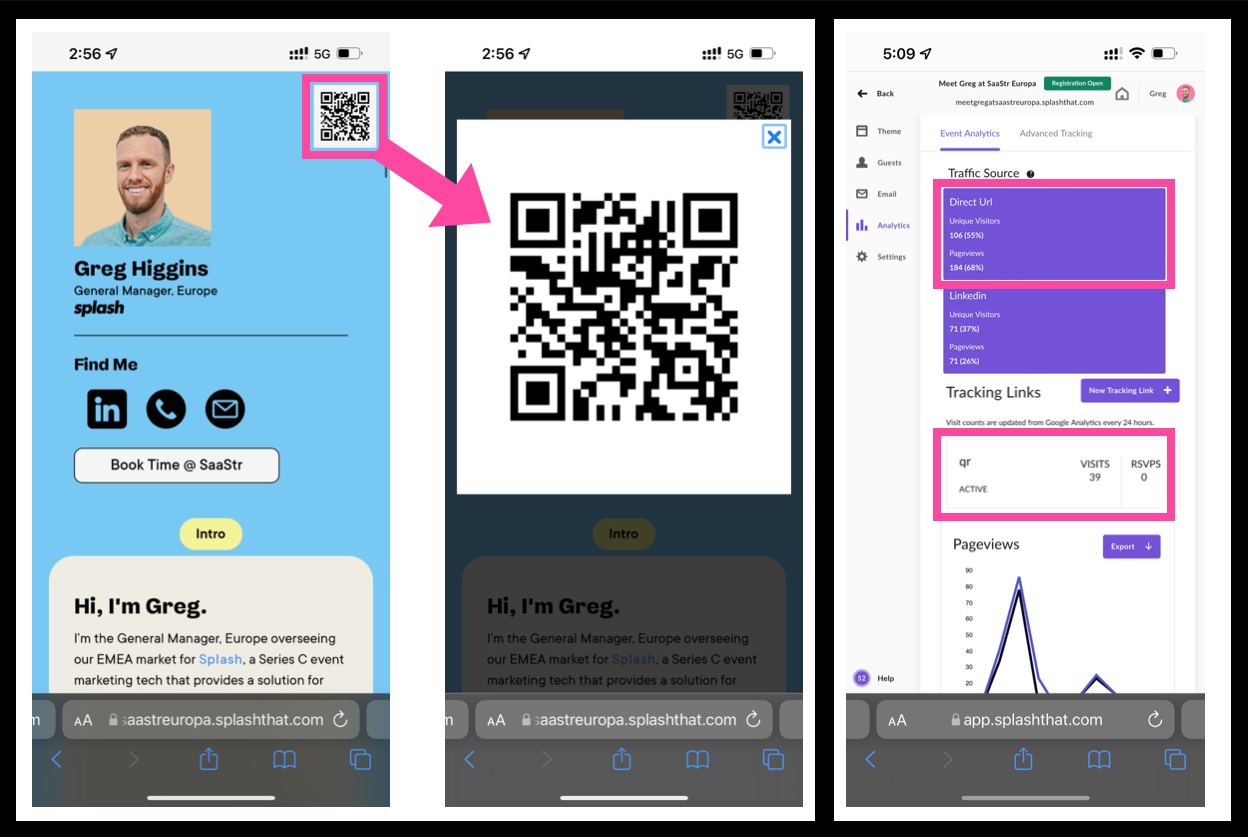
With my digital business card in hand, I could simply share the QR code to invite new contacts to get in touch with me directly from our phones.
Some results:
Nothing crazy but pretty cool for a few hours per day over 2 days.
Some value-based feedback:
Interested in creating your own digital business card at no cost? Create a free Splash account and ping me on LinkedIn. I’d be delighted to connect with you to help you create a stylish, branded card of your own for your next upcoming conference!
During the pandemic, virtual events made us accustomed to looking beyond check-in data and into engagement metrics. Now, with modern event tech companies like Braindate and the tried and true attendee apps like SpotMe and Guidebook, the possibility to obtain the same engagement data exists for in-person events.
At SaaStr, I specifically liked the potential of how Braindate could tell you things like the number of face-to-face connections your team has had. You could know exactly when & where your team is getting s**t done.
Splash can show the ROI of event programs by integrating with your CRM to showcase the funnel influence, conversion rates, and attribution of an event or program (I think our data and reporting capabilities are the best, but I might be just a little biased).
This all has me pondering on the differences between:
A) those who simply “attended” and
B) those who “attended and had a face-to-face interaction.”
I would hypothesize that more (and face-to-face) engagement would likely be correlated with greater revenue impact.
I recommend at least scoping an engagement tool— better yet, try one out! The benefits are both for event profs thinking about optimizing and/or growing their programs as well as any conference attendees who want to maximize their productivity at in-person events. Let me know if you’ve had success!
As I continue to grow in my career, something I’ve noticed that makes a surprisingly big difference is being an active member of a professional community (outside of your workplace).
People involved with groups/organizations outside of their employer/team empower them to grow their careers by consistently building their network, taking advantage of learning opportunities, developing leadership opportunities, and establishing new friendships. A couple of years ago I joined Pavilion, a membership-based organization for high-growth professionals to receive the support they need to build the future they want.
A Pavilion executive member, like myself, communicates and supports each other in a Slack community**.
Leading up to SaaStr, a discussion was sparked in the Pavilion Slack channel asking who was planning to attend the event. . In all, about 25 people indicated they would be there. We started a dedicated Slack channel for the people attending and then formed a WhatsApp group to easily communicate while on-site. We shared our goals for the event, such as who we wanted to meet and what kind of support we needed.
We planned a networking lunch during the conference, stopped by members’ booths, showed up at members’ speaking sessions and events, and made intros to other connections wherever possible.
It was such a comfort going into a conference knowing that you have 24 other people who are not only excited to attend the event but also eager to support you in any way they can.
This experience solidified for me that in-person events have truly return.
Slack communities are the modern-day equivalent of AIM chat rooms, allowing many people to communicate rapidly and efficiently with others with a common interest.
Slack brings people together — from digital nomads to eCommerce-savvy moms and everyone in between. We even have a Splash Slack community to help connect event professionals and marketers and give them a platform to share stories, offer support, and identify resources to help with all sorts of challenges.
If you want to join our Splash Slack Community for event and marketing professionals, check it out here.


