


The One Thing Keeping You From Making the Biggest Impact from Your Events

Published
March 22, 2019
Last Updated
Category
Event-Led Growth
Start Reading ↓
Written by
Matt Heinz
Subscribe to get new blog posts delivered to your inbox.
2
minute read
Complete
Subscribe
More Blog Posts
In a hurry? Read the summary.

By now, we know events are an important part of any marketing strategy (52% of brands believe events are the most effective marketing channel). They provide much-needed face-time with the right audiences to actually move the needle and drive business value (whether it’s through brand awareness, establishing thought leadership, or increasing velocity of buying paths with current and prospective customers).

But the best marketers know the impact of events extends beyond the event itself — especially if you use a strategy that builds on event momentum across other sales, marketing, and customer success functions.

Here's the hard truth: that impact is difficult to achieve — let alone measure — if your event data exists in a silo.

Every interaction with your attendees (before, during, and after an event) provides you with key information (e.g. when they RSVP’d or which sessions they attended) that you can use to better customize follow-ups, nurtures, and even their experience at your future events.

But if this event information isn’t integrated with your other key business systems, you could be missing out on these opportunities, or worse, leaving money on the table and exposing future event programs to budget cuts if you can’t prove the ROI.
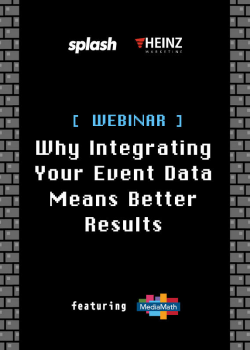
Did you know? I just partnered with Splash for a webinar  on the power of  real-time, integrated event data (featuring an inside look at MediaMath's data strategy).

Watch it on-demand .

What happens when you connect your event data

RSVP forms are an obvious source of collecting event data from guests, but the opportunities don’t end (or begin, really) there. Let’s walk through an example of collecting and connecting event data throughout the event lifecycle (which will show you how powerful integrated systems really are).

Pre-event

  • Your marketing automation platform (MAP) knows which prospects have attended events in the past, and segments them from the “newbies” when you send out invites.
  • Your MAP also tracks which events attendees have signed up for or shown interest in, and feeds those insights into your customer relationship management system (CRM) to inform your sales team’s follow-ups.
  • When a new attendee registers, your event technology pushes notifications to Slack to alert your team in real-time.
  • If you’re hosting pre-event orientation webinars, your webinar platform tracks interest and engagement, and triggers additional emails from your marketing automation inviting high-priority customers and prospects to meetings (as well as calls from sales through your CRM).

At the event

  • Event participation data (e.g. check-ins or no-shows) is fed back to your MAP in real-time, customizing emails to attendees during the event based on what they’ve already done, and what they have left on their pre-event agenda.
  • Intent and engagement data captured at the event (and on event-related content) is scored, pushing some attendees back into your CRM and/or Slack for immediate sales follow-up to set meetings on site before the prospect leaves.

After the event

  • Your sales team’s follow-up tasks are customized based on attendee participation data (synced from your event technology to your CRM), for example talking points based on the content they were most interested in.
  • Event satisfaction ratings (e.g. from a post-event survey) are automatically fed back into your marketing automation platform, updating future event preferences and marketing channels.
  • Event participation details feed into your CRM, so that any future deals are properly attributed back to your event.

Events are full of data, just waiting to be leveraged

The opportunities (and opportunity costs) of connecting your event data with other systems is significant — and nearly limitless. That’s why we put together this brand-new ebook, The Event Marketer’s Guide to integrated Event Data.

It’s an easy-to-read guide that walks through why connecting your event data is so important, how to connect it to key systems, and tips for leveraging it before, during, and after an event to maximize overall impact. Plus: plenty of real-life scenarios and examples from leading organizations.

An automated, integrated event data strategy has often been an afterthought for event organizers, rather than a priority. But integrating event data with the rest of your marketing systems is more important than ever, and will likely only grow as a differentiator between average and remarkable event programs.

Start putting your event data to work. Download our new guide to learn how to leverage your event data to level up on workflow, communications, reporting, and more.

Start putting your event data to work. Download our new guide to learn how to leverage your event data to level up on workflow, communications, reporting, and more.
Download Now
Written by
Matt Heinz
Prolific author and nationally recognized, award-winning blogger, Matt is President and Founder of Heinz Marketing with 15+ years of marketing, business development and sales experience from a variety of organizations and industries. He is a dynamic speaker, memorable not only for his keen insight and humor, but his actionable and motivating takeaways.

See Splash in action. Get started today.

Book a Demo